The code does not ask for brightness. It asks for duration.
IBC 1025 and IFC 1025 require marked egress paths in high-rise buildings, and UL 924 defines how long a sign must remain legible after power loss. Photoluminescent material meets that requirement without a battery, a circuit or an inspection schedule.
Values per ASTM E2072 / E2073, measured after the standard 15-minute charge at 25 lux. Decay follows a power law, not a straight line — the 90-minute figure is the one codes reference.
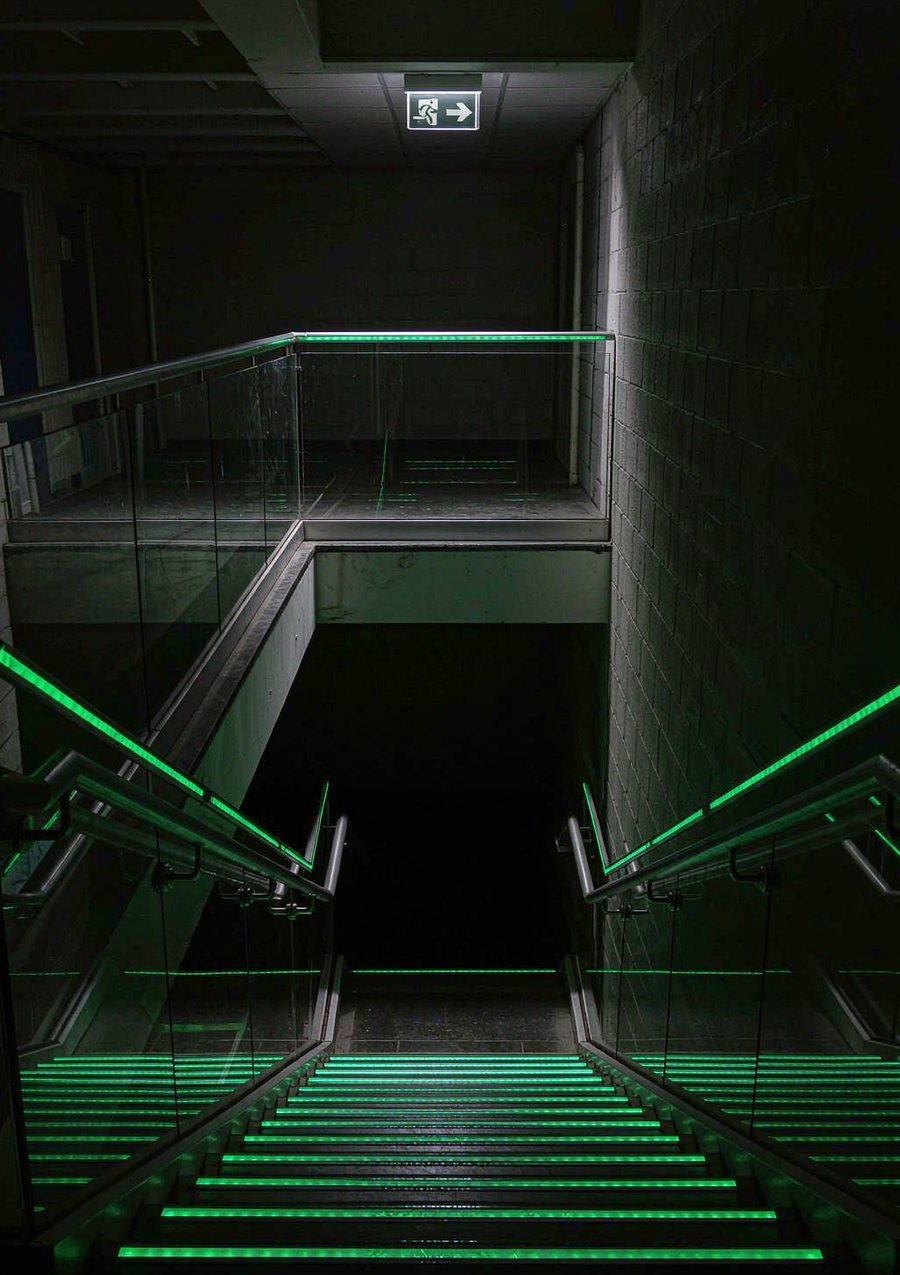
Four formats, one decay curve.
All four use the same strontium-aluminate pigment. The difference is the carrier and the format, not the photometric performance.
| Model | Product | Format | Luminance 10 min | Standard | Use |
|---|---|---|---|---|---|
| NVR-PL9 | Exit sign | 300 × 150 mm, rigid PVC | 120 mcd/m² | UL 924 | Door and corridor exits |
| NVR-PL45 | Egress path marking | 45 mm × 30 m roll | 110 mcd/m² | ASTM E2072 | Floor and stair path |
| NVR-PL30 | PL film | 300 µm, 610 mm wide | 95 mcd/m² | ASTM E2072 | Die-cut signage |
| NVR-PLSN | Stair nosing insert | 60 mm, aluminium carrier | 105 mcd/m² | IBC 1025 | Step edge marking |
Three mistakes that fail inspection.
Learned from projects where the material was right and the installation was not.
A sign above the exit is useless if the occupant cannot find the corridor. The code requires a continuous marking at floor level or handrail height leading to the exit.
PL material needs 25 lux of ambient light for 15 minutes. Corridors on occupancy sensors may not provide it — check the lighting schedule before specifying.
PL film on concrete needs a primer; on vinyl tile it does not. The wrong choice shows up as a curled edge within one season, not at handover.
Compliance pack
For code officials and consultants: